


Most agents' databases are a long list of separate contacts, with spouses, kids and parents stored one by one and nothing tying them together. ZachCRM is a real estate CRM built around households instead of contacts. People who live, buy and belong together are grouped into one household, so 2,000 contacts might become about 900 households you can actually keep up with, and every person inside still keeps their own phone, email, birthday and details.
The problem with 2,000 loose contacts
Almost every CRM stores people one at a time. Over a few years of selling, that list fills up with a spouse added as a second contact, the kid who just bought their first home, the parents who downsized, and the past client whose sister you met at closing. None of them are connected unless you link them by hand, one relationship at a time, and almost nobody keeps that up.
- You cannot tell at a glance who belongs with whom. Is J. Martinez Daniel's wife or his sister?
- Follow-ups double up. One couple gets two reminders on two different days, so you either call twice or quietly skip one.
- What you learn gets split. She told you about the move, but the notes are on his record.
- The list looks bigger than your business, which makes it hard to tell whether you are really staying in touch with the people who matter.
2,000 contacts, about 900 relationships
Group those same people by household and the number drops fast. A couple becomes one household, a family becomes one household, and 2,000 contacts might turn out to be 900 relationships. That is a list a real person can work: one follow-up date per household, one line on today's list, and one timeline of everything that has happened.
You do not have to do the grouping by hand. When you import from your old CRM, couples that come out as two contacts land in one household.
Relationship details, used the right way
Relationships rarely belong to one person. The kids' names, the dog, the job change, the lake place they keep bringing up: that is household information. In ZachCRM it lives on the household's FORD notes (family, occupation, recreation, dreams), next to talking points you queue for the next call and the people they have referred to you. All of it shows up in call prep, right before you dial.
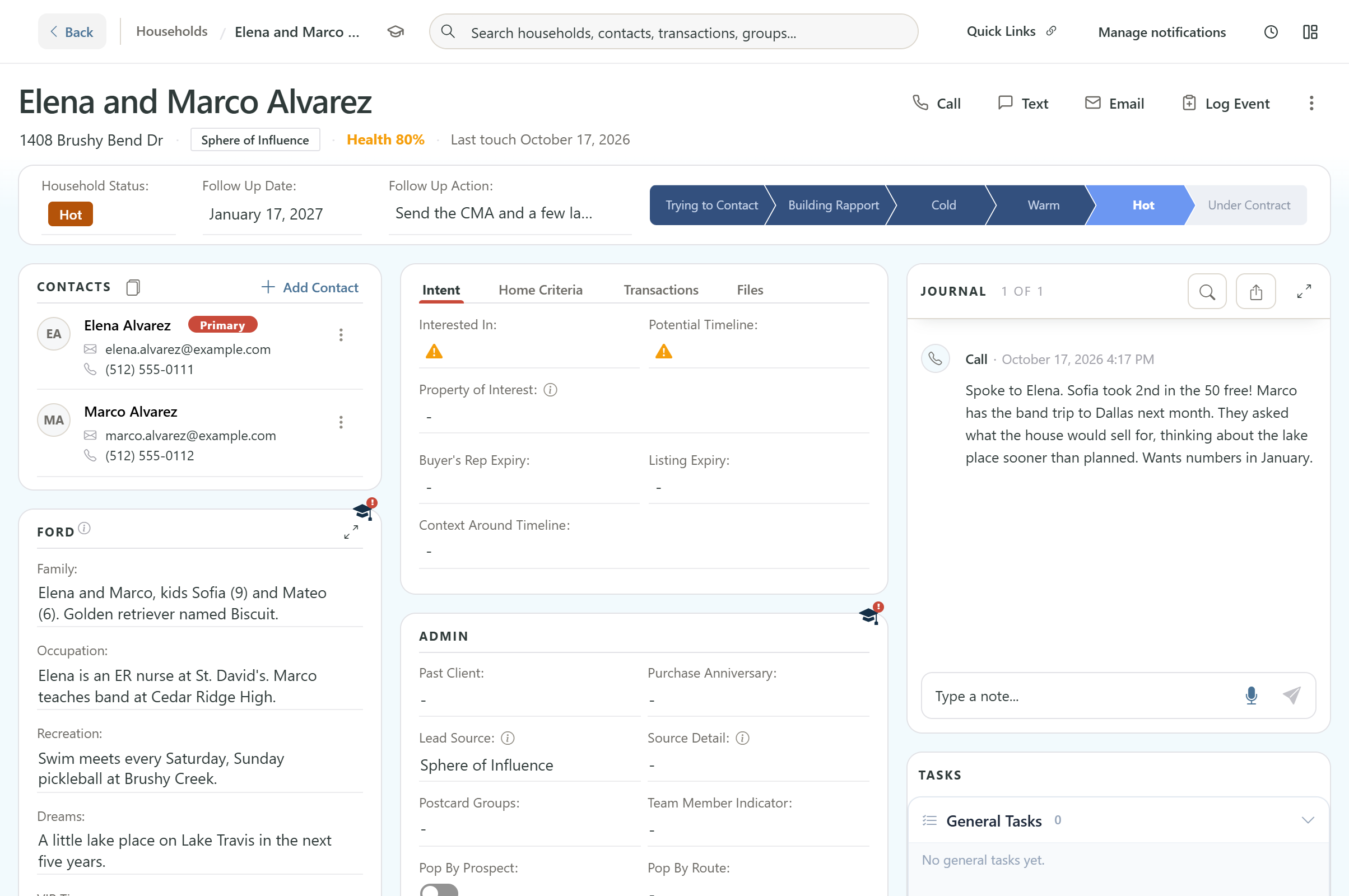
And still personal, one person at a time
Grouping people does not blur them together. Each person keeps their own phone, email, birthday and social links. You can call Elena about the swim meet, text Marco about the band trip, or group text them both, and the journal records who you talked to. Birthday reminders come per person and purchase anniversaries per household, so the personal touches land on the right person on the right day.
Why it brings clients back
Repeat and referral business comes from people feeling remembered. Asking whether their daughter beat her swim time is the call they mention to friends. Working by household makes that the normal thing to do instead of a feat of memory: fewer records to keep up with, richer notes on each one, and a next step on every relationship.
Contact-based CRM vs household-based CRM
| Contact-based CRM | ZachCRM (household-based) | |
|---|---|---|
| Your database | 2,000 separate contacts | About 900 households, with the people inside |
| Relating people | Linked by hand, one at a time | Grouped on import; everyone in a household is connected |
| Follow-up reminders | One per contact | One per household |
| Notes and call history | Split across people | One timeline per household |
| Rapport details | Buried in one person's notes | FORD notes on the household, shown before you dial |
| Reaching people | One contact at a time | One person, or the whole household at once |
| Your past client count | Counts people | Counts relationships |
Moving your database in
Export a CSV or Excel file from wherever your contacts live now. The importer groups couples into households and turns years of inconsistent tags (every spelling of "past client", "buyer", "sphere") into real fields. Most agents are imported and set up in about five minutes.
Questions agents ask
What is a household-based real estate CRM?
A CRM where the record you work is the household, not the individual contact. The people who live or buy together are grouped inside it, each with their own details, and the follow-up date, notes, transactions and history belong to the household.
Does each person still have their own phone number and email?
Yes. Every person in a household keeps their own phone, email, birthday and social links. The household groups them; it does not merge them into one.
Can I text or email everyone in a household at once?
Yes. From the household, on your phone or your computer, you can send a group text or a group email to everyone in it. It logs to the journal as one activity against the household.
What about families, or a parent buying with an adult child?
A household is not limited to two people. Add whoever is part of the relationship, and each of them keeps their own details.
What happens if a couple separates?
You can move a person out of a household into a new one of their own, so each side keeps a clean record going forward.
How much does ZachCRM cost?
ZachCRM is $50 a month (plus sales tax where it applies), one price no matter how many households you keep, with a 14-day free trial. See pricing.